
Balancing acts: navigating health and work in real life
 About 7 mins

Balancing acts
Navigating health and work in real life

Download a text-only version of this feature
Health and employment are deeply intertwined. For many individuals, especially people dealing with chronic health conditions or disabilities, managing health and work can feel like an uphill battle.
1 in 5
working-age people in the UK have a health condition that limits their ability to work
In the UK in 2023, 8.2 million people reported having a long-term health condition that limited their ability to work – an increase of 2 million since 2013. That's almost 1 in 5 working-age people across the UK.
Behind this statistic, there are unique stories and perspectives that often remain untold. These aren’t just numbers, but real people's lives shaped by barriers many of us never have to consider.
In March, the government set out plans to reform disability benefits and support. The Pathways to Work consultation closed on 30 June, and we've recently published a health impact assessment of the proposed reforms.
Many people are speaking out to highlight why employment support is so crucial, and to underline the risks to people's physical and mental health when adequate support is not in place.
As part of the Commission for Healthier Working Lives, the Health Foundation commissioned ClearView Research to explore and document the experiences of individuals living with health conditions and the impact on their ability to work.
ClearView Research consulted 263 people in three areas of England and Wales. Interviews and workshops provided unfiltered insights into the intricate balancing act of managing health while maintaining employment.
Here's what they said.


Challenges balancing health and work

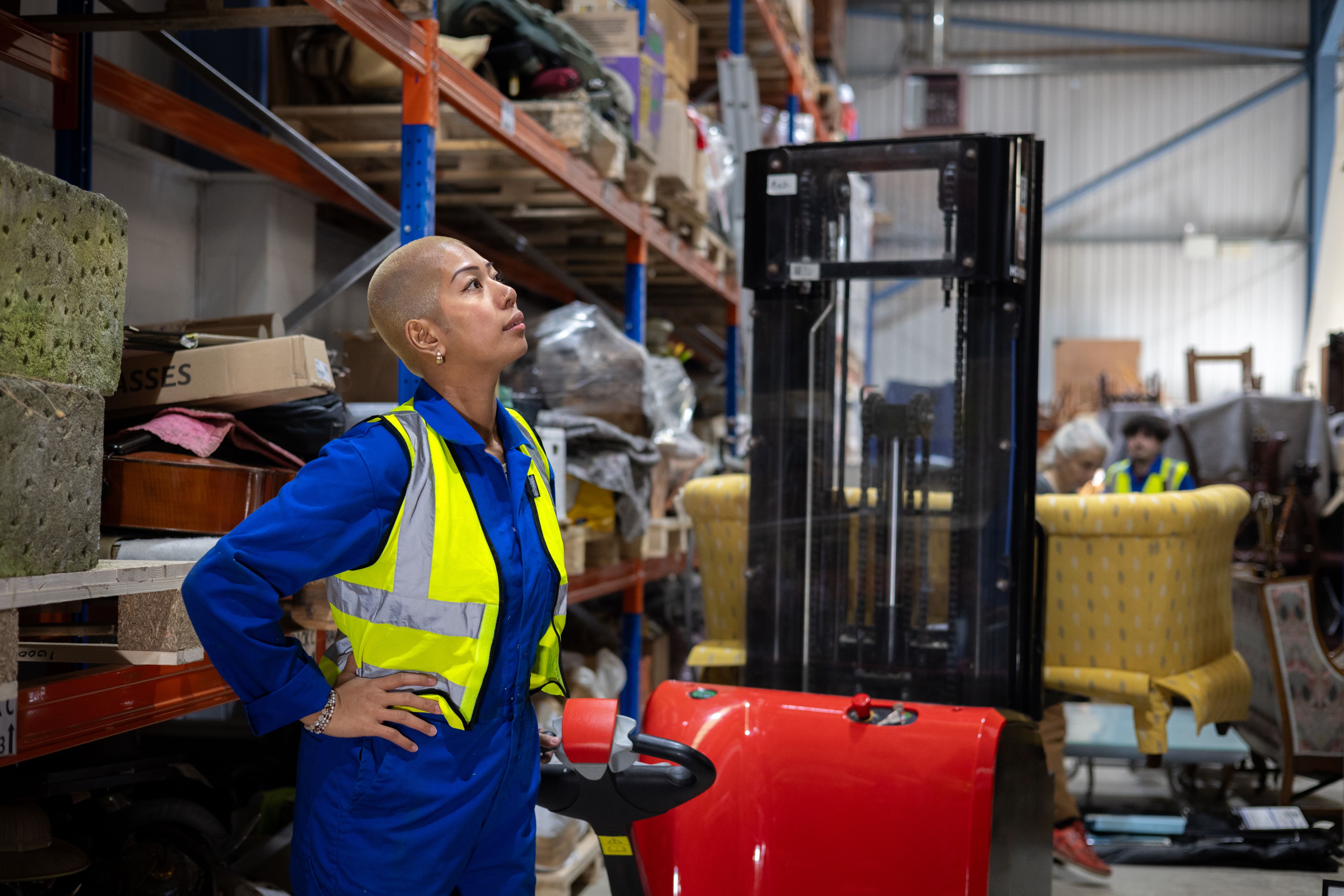
During the workshops, people shared the challenges they face, and explained the resilience and resourcefulness needed to navigate life’s demands.
We've changed people's names to protect their identities.
Managing pain
'This morning I felt a lot of pain. I normally do have what I would call "edge pain", where even with pain medication it’s really there in the background. After suffering a late night and not much sleep, the pains generally intensify and do end up being like migraines, and like neurological pain. So all the nerve endings from my toes, to my back, to my head, to my eyes, you name it, just flare up.'
– Robert
Managing energy levels
'I describe it as working with a broken phone battery. So, somebody will go to sleep and they'll charge and they'll have 100% charge the next morning. When I was really poorly, I had 2%. I could only get to the bathroom and back. That was for months. Now it's probably 60% on a good day. But I'm not going to have a good day every day.'
– Mary
Line management
'I had a manager I'd worked with for over 20 years. She knew me and my quirks and my idiosyncrasies. When she retired, the new manager had absolutely no time for any of the things that were informally in place. I've never been very good at getting in at 9 o’clock in the morning but would always do the work. And that caused, I think, the breakdown that I had.'
– James
Fighting stereotypes
'There are assumptions made about my health conditions. I always have this feeling that I've got to prove myself in every situation that I'm in. I'm fighting those stereotypes.
'When I say I need a reasonable adjustment for something physical, they assume it's because of my weight and that's not necessarily true. In the past I've had more negative experiences where somebody's basically gone, ‘Well, that’s your own fault so we can’t make an adjustment for that.’ That's not OK but then I've not had the self-esteem and been able to speak up for myself.'
– Chloe
Navigating the system
'There's an Access to Work Fund, but guess what? You can't find out how much money you can get from it until you've already registered as self-employed and got your basic tax code number. At that point, you've committed to being self-employed. So, you can't actually claim benefits. There isn't a navigator who'll sit there with you and say, 'This is how you get through this system.' I need somebody to help me find my way through that system. Without that support, which is effective and personalised to me, I'd have to do it all by myself.'
– Charles
Exhausting anxiety
'I do suffer with anxiety quite a lot. I rarely miss work, but I may some days struggle. If it's a particularly busy day and there's lots of meetings going on, it can be quite exhausting. By the end of the day, trying to keep the anxiety in check, do the job and then just get home.'
– Sandra
Home adaptations
'I became a wheelchair user quite recently, and my house is just not suitable at all. I'm in this in-between where I earn too much money to have a Disabled Facilities Grant for them to actually do the work. I was like, "I don't know anything about ramps or wheelchairs, or accessible kitchens or showers. Can you at least give me some advice? Or at least tell me where to go so I can pay for these things myself? If I have to pay for them myself, that's fair enough – but tell me what I need to do. Tell me some trustworthy builders." And then it's just like "no." Nothing. Not a leaflet, not anything.'
– Yasmin
What does effective support look like?


The people engaged in this project spoke clearly about systems of support that have worked well for them, and those that haven’t. Their stories show how compassionate and well-structured systems could be uplifting and empowering, while inadequate ones exacerbate challenges, sometimes leaving them to navigate their health and work struggles alone.
People told us that effective support systems prioritise individual needs, foster empathy and enable timely interventions. Effective support doesn’t just address issues, it anticipates them, creating environments where people feel valued and understood.
This includes...
A supportive employer
‘My current employer is really understanding. They let me work from home when I’m not feeling well and have a clear process for taking mental health days. It’s made a world of difference to how I manage my condition.’
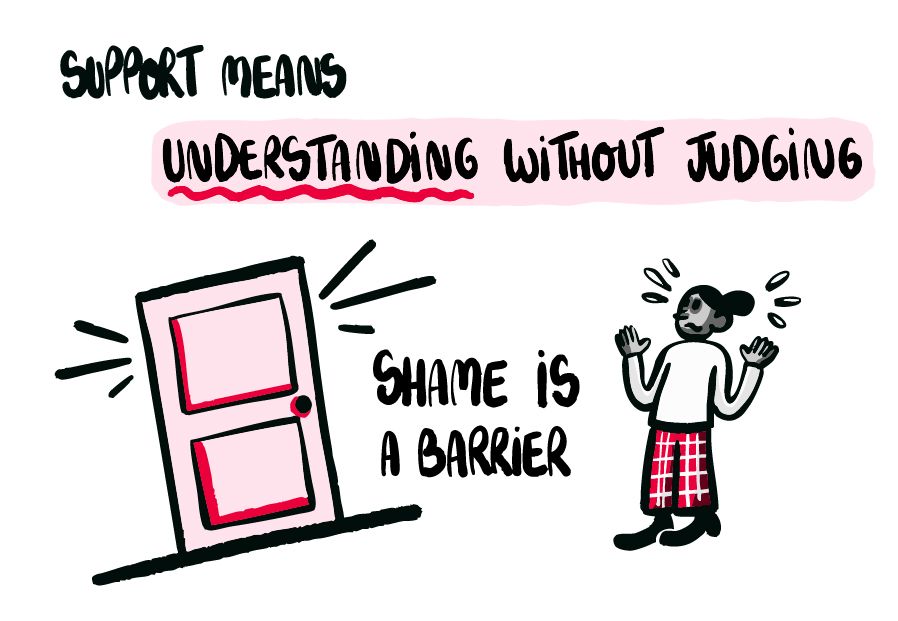
Understanding
‘Support means understanding without judging. Shame is a barrier.’

Flexible working
‘Since my company introduced mental health days, I’ve felt more balanced and supported in managing my stress.’
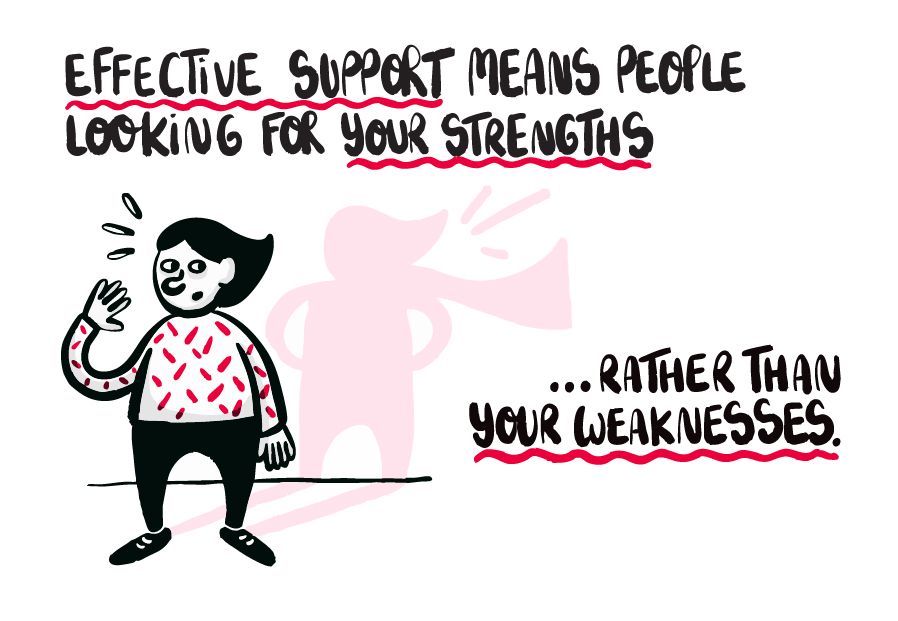
Belief in your abilities
‘Effective support means people looking for your strengths rather than your weaknesses.’
Support from family
‘Because I've got arthritis in my hand, some mornings are really painful. So I get my husband to drop me off at work and pick me up as well. So that's a great thing, to be able to rely on someone.’
Time to answer questions
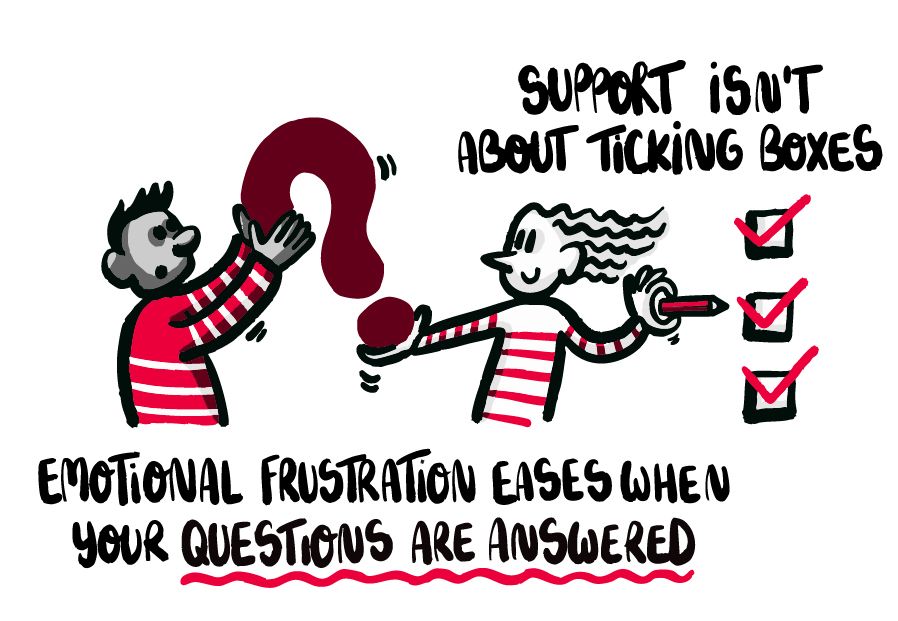
‘Support isn’t about ticking boxes. Emotional frustration eases when your questions are answered.’
Coordinated support
‘What would be really useful is when you ask for help with your GP, or if it's a council, or if it's your care worker, everyone can talk to each other, so you're not repeating yourself 1,000 million times.’
Reimagining solutions


The people engaged in this project have consistently called for systems that prioritise inclusion, empathy and seamless coordination.
They envision workplaces where health needs are addressed without fear of judgement. They imagine health care systems where accessibility and integration are the standard, not the exception.
Their voices challenge employers, policymakers and health care providers to act.
Workplaces must:
- adopt flexible policies
- provide mental health resources
- foster open dialogues about health.
The health care system needs to:
- reduce wait times
- ensure parity between mental and physical health
- integrate care pathways to minimise patient burden.
Behind the scenes
To understand the experiences of people navigating health and work, this research embraced a collaborative and participatory approach, ensuring the voices of people directly impacted were front and centre.
Co-creation
ClearView Research recruited a co-creation group, including people from Coventry (West Midlands), Northumberland (North East of England) and Newport (South Wales).
The co-creation group shaped the research, refined questions and provided feedback on findings. The group weren't just participating – they were leading the charge to ensure the study reached and reflected real people.
Mini-ethnographic study
For 2 weeks, the co-creation group took part in a mini-ethnographic study using online diaries to share how their health impacted their work choices.
Peer-to-peer interviews
ClearView Research recruited and trained six community researchers to conduct in-depth interviews within their local areas of Coventry, Northumberland and Newport.
In-person workshops
During three workshops in Coventry, Northumberland and Newport, people shared their experiences and discussed the systemic barriers they faced.
These sessions weren’t just about identifying problems. They were about imagining solutions. Participants offered practical recommendations to improve health care and workplace support, creating a roadmap for change grounded in their realities.
From the co-creation members to the peer-led interviews and narrative workshops, every voice contributed to a richer, more inclusive understanding of the experiences of real people who make up the big statistics.
This collaborative approach wasn’t just about gathering data. It was about building a truthful narrative to inform meaningful change.
Further reading on work and health
Action for healthier working lives
This final report from the Commission for Healthier Working Lives sets out the need for a new approach to work and health, with seven key recommendations to lay the foundations for long-term change

Lived experiences of work and health
This report from ClearView Research explores how health challenges can shape working lives, and outlines the opportunities to build truly supportive, inclusive systems
Shaping better policy through real experiences of work and health
Jes Phillips explains how collaborating with people who have lived experience of health and work challenges can improve understanding and shape better policy.
 Built with Shorthand