
Improving NHS productivity is within our gift
An interview with Anita Charlesworth and Tera Allas
 About 6 mins
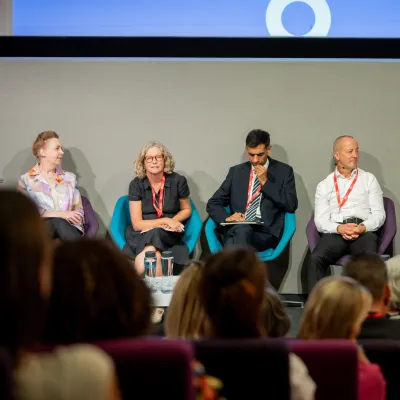
Anita Charlesworth and Tera Allas are leading experts on productivity and co-chaired the NHS Productivity Commission. After 18 months, the Commission’s final report, Breaking the cycle, was published last month. We spoke to Anita and Tera about how to improve productivity in a complex, people-driven system like the NHS.
Why did you both want to lead the NHS Productivity Commission and what work fed into its final report?
Anita: For over a decade now the Health Foundation has been looking at the long-term sustainability of the health care system and how we can create an NHS not just fit for today but able to thrive into the future. It’s become increasingly apparent, brought into sharp focus by the pandemic, that improving productivity is key – both to improving NHS sustainability, but also to improving health outcomes, and therefore helping our wider economy to thrive.
We didn't want to spend loads of time admiring the problem. We wanted to focus on what we could do about it.
Tera: I was delighted when Anita asked me to join the Commission as co-chair. I’ve spent at least half of my career looking at how to improve productivity, whether in the private or public sector. I'm also passionate about wellbeing and constantly reminded of the fact that health is the number one driver of life satisfaction. If we want to make people's lives better, we need to make their health better.
The commission ran for 18 months, with pairs of commissioners looking in detail at each of the key drivers of productivity, and an expert advisory panel providing input and challenge on the solutions we were coming up with. We also did important stakeholder engagement and had a fantastic secretariat at the Health Foundation contributing independent research.
The final report distils all of that learning down into just 10 recommendations, focused on specific things that we think are implementable and could start to move the needle.
What happens if the NHS doesn’t improve productivity?
Anita: There’s always the fear that if we don’t do something we’ll just be presiding over a managed decline of the NHS, where people who can afford it start to go private for health care and the social contract frays.
The real, immediate risk though, is that people are much less healthy than they need to be. In our report we show that delivering on productivity improvements could significantly reduce deaths from treatable causes (we estimate 18,500–20,600 lives could be saved each year) and also increase the number of years that people live in good health.
If we can get our economy firing on all cylinders with a healthier workforce, that will also improve the tax revenues that allow the NHS to flourish. You start to get into a virtuous cycle, one with profound importance to the NHS, to individuals and to our economy.
Tera: Most crises develop gradually and then suddenly. It's the old dripping tap in the bathtub analogy. Drip, drip, drip. Eventually it’s going to spill over, but it’s hard to predict exactly when. But whatever future scenarios we look at, if the NHS declines, the quality of care that people get will deteriorate, and so will people’s health. We should not, and don't need to, accept that outcome.

A lack of productivity is often associated with too much waste. Is this the case in the NHS?
Anita: There’s interesting work from OECD that suggests the NHS actually doesn't have as much waste as some other health systems. But yes, there is waste in the NHS. Three areas were really highlighted through the Commission’s work.
First is failure demand, where the NHS ends up doing things (like more serious procedures) because something else didn't happen earlier at the right time or in the right place. That’s avoidable cost for the NHS, but it’s also not good for patients.
Second is time spent compensating for failures to have the right equipment or the right flow. For example, bottlenecks elsewhere in the system meaning more resources are needed in A&E.
Third is when people have to do things that technology should be able to do for them. Not just staff, but also all the work patients have to do to make the system work for them.
The Commission makes 10 recommendations for improving productivity. Which are the most straightforward to implement and the most challenging?
Tera: It’s tricky. Something can appear to be technically quite straightforward but rely on people in the system being willing to change, or on politicians prioritising it.
Our recommendation around building managerial capability isn’t technically difficult. It will cost some money, but not enormous amounts, and it’s not hugely controversial. So that feels like something to just get on with. If we really prioritise it, a lot of other things will start falling into place.
Anita: Although it seems like stopping the constant churn in the NHS is out of our hands, I do think committing to setting out clear long-term plans in terms of funding is an achievable goal. In fact, a treasury willing to do that just looks like good government as far as the financial markets are concerned.
It gets more challenging when we come to the recommendations about devolving accountability and giving organisations and teams greater flexibility over how outcomes are achieved.
As a mission-driven service, there should be real clarity about what the NHS is here to do. Instead, we have this proliferation of targets and metrics and management by process. Much of it reflecting very low trust between different tiers of the NHS and with politicians. It’s born of good intentions, but it means people have no freedom to act.
Tera: All that compliance takes a lot of time. And time is money when we're talking about a service driven and delivered by people, so there's a double whammy here. People are distracted because they have too many things to do and no clear north star. They’d much rather spend their time looking after patients or redesigning local delivery.
We're therefore arguing for a fundamental shift in mindset and approach. It sounds scary, but there’s so much evidence out there that it shouldn't be. If you move to a more trust-based, more empowered but accountable and properly capability-supported system, you do get the best of both worlds. You get better front-line delivery and better outcomes.
You are both experts in this field. What surprised you from the Commission’s work?
Anita: The Commission looked at learning from other parts of the economy and other countries. One of the things that I've really taken away is how fundamentally important staff engagement is as a driver of productivity. It’s not a ‘nice to have’ when you've sorted everything else out. It is absolutely the route to sorting everything out: the route to transformative productivity change.
Tera: I agree. I hadn’t anticipated how much culture would be at the heart of many problems. I’ve spent 18 months hearing how a different approach to empowerment and accountability would help leaders and staff deliver a better job. But then each week another NHS failure is reported in the media. And the political reaction is so completely out of kilter with this diagnosis of a culture issue, with more micromanagement levers introduced to compel staff to behave ‘properly’. There’s such a mismatch between what everybody diagnoses as the problem and then what comes up as solutions from the political and policy machine.
What positives are you taking away about the NHS and its future sustainability?
Tera: We have a fantastic starting point from which to build. The NHS is made up of a lot of very qualified, intrinsically motivated, well-meaning people who are good at their jobs. And there's an enormous amount of innovation, good practice and ingenuity throughout the system. If we create the conditions to let those positives flourish, then we could deliver so much more health for the same amount of money.
Anita: One positive I’m taking away is just how much agreement and consensus there is across the system about what needs to happen. Another, similar to Tera, is just a sense of the enormous, untapped potential that can be unlocked by changes within national policymakers’ and system leaders' power. There are lots of things we can’t change in this country. But the NHS is within our gift. For our children and our grandchildren, we need to step up and lean in and make it the best it can be.
This content originally featured in our deep dive newsletter.