
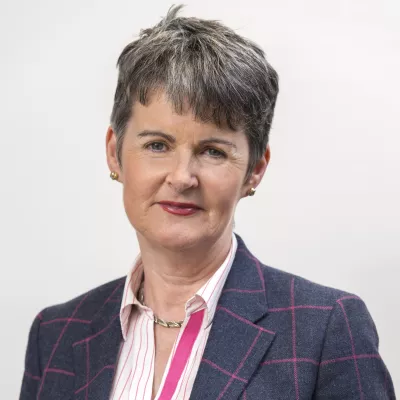
Dr Anne Kilgallen Deputy Chief Medical Officer
Organisation: Department of Health, Northern Ireland
- Quality Improvement Fellowship
- 10
Areas of interest
About me
Anne is a Quality Improvement Fellow and Deputy Chief Medical Officer at the Department of Health, Northern Ireland.
She was a Quality Improvement Fellow in 2013/2014, based at IHI, Cambridge MA. At the time of her fellowship, Anne was Medical Director and Responsible Officer for the Western Health and Social Care Trust.
She was the trust’s executive lead for quality and safety, and is particularly interested in learning about leadership behaviours that can bring about genuine patient-centred organisations.
Anne has spent almost 20 years specialising in health provision in Republic of Ireland and Northern Ireland. Most recently, she has played a significant role in reconfiguring her trust’s hospital services to create a safer, more effective services model.
Anne believes that for an organisation to change to consistently deliver high-quality care requires the application of proven techniques by motivated staff with improvement skills. ‘In the NHS, we talk about patients being central to everything we do, and we truly mean it, but making that a reality is much more challenging than many people realise,’ says Anne. ‘As an individual in an influential position in a healthcare organisation, I believe it is my job to make sure that everything that I do makes it clear that being patient-centred is at the core of our work.’
While in Boston, Anne hoped to learn from organisations that have already discovered what it takes to be patient-centred, as well as those who are new to the challenge. She especially wanted to gain firsthand experience of the Institute for Healthcare Improvement’s (IHI) Triple Aim initiative, an approach developed by the IHI that describes a framework for optimising health system performance. She hoped to bring back fresh know-how and tools that can help her organisation develop.
‘I need to learn more about the evidence, the tools and leadership techniques I can use to spread patient-centred care organisation-wide. I want to develop the skills that will allow me to translate how to do it effectively and why.’
Anne believes the single most important behaviour to change is her own, she said, ‘This year will give me the time to think through and learn how I as a leader can behave in a way that it is patient centred. I need to be able to show others how we can do it.’
When Anne returned from Boston, she intended to lead a review of the trust’s quality and safety strategy and implementation plan to apply the knowledge she has gained. She also worked with the postgraduate dean to design training opportunities to build junior medical staff’s capacity to drive continuing improvement.
What matters to me
Since September 2014, Anne has been working on secondment at the Department of Health for Northern Ireland with responsibility for public health policy development. In that role, she has advocated for the intentional development of systems for improvement and innovation in health and social care, to improve outcomes. In December 2016, following publication of a new strategic vision for Health and Social Care, Anne was asked to lead the work of designing an Improvement Institute for Northern Ireland and the approach to scale and spread of innovation and best practice across the region.
Following initial work involving many stakeholders, senior leaders have accepted the need to build a regionalised approach to improvement and innovation. This will be an institute that is a multi-centred network, with appropriate infrastructure that people need to improve and innovate at scale.
Anne has brought a number of people together with the shared interest of establishing a design collaborative. The key task just now is to understand in depth how improvement and innovation currently happen. She is about to embark on a process to identify one or more outcomes that matter sufficiently to mobilise people to co-design and begin prototyping a regionalised approach to improvement, in order to test and learn together.