Indicator
Neighbourhood belonging and mental health, by age
Published
4 March 2024
Last updated
4 June 2025
Time to read
 About 2 mins
About 2 mins
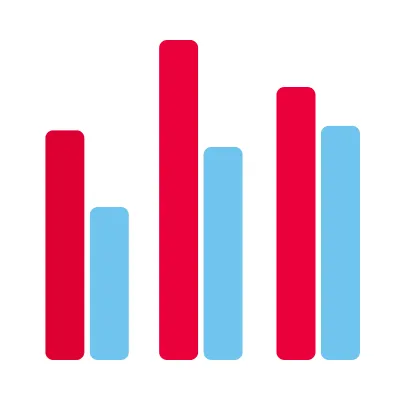
People who don’t feel they belong in their neighbourhood are more likely to experience poor mental health, regardless of their age
This chart shows the impact of belonging to your neighbourhood on the proportion of people experiencing severe psychological distress in 2020–21, broken down by age group.
- People in all age groups are more likely to experience severe psychological distress if they feel they don’t belong in their neighbourhood.
- Feeling like they belong in their neighbourhood has the biggest impact on health for people aged 35–44, who are 4.8 times more likely to experience severe psychological distress if they don’t feel they belong. This is followed by people aged 55–64 (4.6 times) and 65+ (3.9 times).
- Neighbourhood belonging matters the least for health for people aged 25–34, who are only 3 times more likely to experience severe psychological distress if they don’t feel they belong.
- Psychological distress is measured using the GHQ-12 assessment tool – recognised and widely used to assess a person’s mental health. It includes 12 questions relating to mood dysfunction, social dysfunction and loss of confidence. Each question has a four-point response scale. Responses are added up to give an overall distress score – people with a score of 20 or higher are classified as experiencing severe psychological distress.
- Neighbourhood belonging is measured using the survey question ‘Please answer how strongly you agree or disagree – I feel like I belong in my neighbourhood.’ Respondents answer on a five-point scale (strongly agree, agree, neither agree nor disagree, disagree, strongly disagree). For this analysis, this scale has been condensed to a three-point scale (strongly agree and agree, neither agree nor disagree, strongly disagree and disagree).
Source: Health Foundation analysis of University of Essex – Institute for Social and Economic Research, Understanding Society, UK, 2020–21