Unfortunately, your browser is too old to work on this website. Please upgrade your browser
Skip to main content
Briefing

Health at the heart of local growth
Local levers to take the handbrake off economic development

Published January 2026
Time to read clock icon About 15 mins
Authors
Aerial view of large houses with gardens and trees

Key points

  • Improving people’s health, especially in the UK’s most deprived communities, is an economic necessity. Poor health reduces people’s ability to participate in the labour market and drives economic inequalities between local areas. Addressing ill health is essential to boost productivity, support inclusive growth and strengthen the economy as a whole.
  • This briefing shares some of the ways public health and economic development teams can work together to incorporate health into local growth strategies. It focuses on three interconnected ‘pillars’ for improving local economic growth: employment support and skills development; employers’ role in good work and local procurement; and investment and infrastructure.
  • Long-term sickness has become the main driver of economic inactivity in the UK. Working-age people in more deprived areas are more likely to die prematurely and more likely to spend a greater proportion of their working lives in poor health. These inequalities are projected to persist through to 2040 based on current trends.
  • The government has committed to ‘raising living standards across every part of the United Kingdom’. But investment in economic development – in areas such as housing, skills, transport and regeneration – will only improve local economies if strategies and interventions recognise two crucial factors: improving physical and mental health, and reducing inequalities.
  • Addressing high levels of economic inactivity due to ill health is a major priority for the government, strategic authorities and local authorities, through the Get Britain Working strategy and the Connect to Work programme. These approaches need to be part of broader system-wide action to keep people in work and to prevent ill health and inequalities in the first place.
 

Introduction

Improving health is key to improving economic participation, for the benefit of individuals and both national and local growth. While the government has committed to ‘raising living standards in every part of the United Kingdom’, high levels of ill health in deprived areas are reinforcing existing disadvantage and a cycle of low productivity, poor health and weak labour market outcomes.

Economic development policy and activities can enhance a region’s economy through investment, innovation, infrastructure and skills development, with the aim of improving productivity and employment. If successful, these activities can improve health and wellbeing, while contributing towards local economic growth. But they can only do so if they recognise health as a critical factor, alongside economic measures.

A new approach from national government is needed so that all places can benefit from stronger economies and good health, to make economic growth a reality everywhere in the UK for the benefit of all communities. The new statutory health duty and mandate for strategic authorities to develop local growth plans, being introduced by the English Devolution and Community Empowerment Bill, provide an opportunity to improve health and address persistent economic, health and other inequalities within and between regions. 

About this briefing

The Health Foundation has been working in partnership with local and regional government to support economic development teams to consider health. Working with the Growth and Reform Network, we have developed an understanding of the joint benefits possible across economic development and health, as well as the critical success factors.

We have identified three ‘pillars’ of economic development to prevent poor health acting as a brake on local growth. This briefing is designed for economic development teams in strategic authorities and local government seeking to incorporate health into growth strategies. We set out the levers available to local and regional tiers of government, referring to existing good practice. We draw on evidence from a mix of interventions: some fully evaluated, some with early-stage evaluations and others with emerging approaches that are not currently evaluated. 

Anchor organisations are large, place-based institutions rooted in a local area that exert significant economic, social and environmental influence on their surrounding communities. They can include public sector organisations such as NHS trusts, local authorities, universities, housing associations as well as private sector businesses. Because of their scale, stability and purchasing power, anchor organisations can influence local economies and health through employment and workforce practices, procurement and supply chains, and how their land and assets are used. 

Economic growth refers to an increase in an economy’s total output of goods and services over time. It is typically measured by the growth rate of real gross domestic product (GDP). Economic growth reflects an expansion in a country’s productive capacity and income levels.

Economic inactivity refers to people of working age who are neither in employment nor actively seeking work. This includes people who are long-term sick or disabled; carers; students not seeking work; early retirees; and people who are not actively job-seeking. Poor health is a leading cause of economic inactivity, particularly long-term conditions, eg musculoskeletal disorders, cardiovascular disease; mental ill health (eg depression, anxiety); and disability and chronic pain. Economic inactivity can itself worsen health through reduced income and financial insecurity, and increased social isolation.

Gross domestic product (GDP) measures the total monetary value of all final goods and services produced in a country over a given period. It is commonly used to assess overall economic performance; economic growth or contraction; and fiscal capacity of the state. GDP shapes the economic context in which health systems and population health operate and determines resource availability. Higher GDP can increase government tax revenues and create capacity to fund health services, public health programmes and investment in housing, transport and community infrastructure. 

Premature mortality refers to deaths that occur earlier than would be expected given a population’s life expectancy. In UK and OECD contexts, it is most commonly defined as deaths before 75 years that could be reduced through effective prevention and timely treatment. It is a core indicator of health and inequality because it reflects exposure to social, economic and environmental risks; is strongly patterned by deprivation, occupation, education and place; and highlights deaths that are potentially avoidable. It reduces the size of the working-age population and undermines workforce participation, productivity growth and business investment confidence.

Productivity refers to the efficiency with which inputs (such as labour, capital and time) are converted into outputs, most commonly measured as output per worker or per hour worked. Good health improves attendance, concentration and work capacity, while ill health reduces productivity through sickness absence, presenteeism and early labour market exit. Higher productivity supports economic growth and tax revenues, increasing the resources available for health care, public health services and prevention. Productivity gains driven by poor job quality, excessive workloads or unsafe conditions can damage health, undermining long-term workforce sustainability. Low productivity is often concentrated in areas with poor health, reinforcing cycles of deprivation and health inequality.


Ill health and long-term economic decline

In recent years the UK has faced rising levels of economic inactivity among its working-age population. Long-term sickness has become the main driver of economic inactivity, posing a significant threat to growth, productivity and fiscal sustainability. The Office for Budget Responsibility warns that poor population health is a major long-term fiscal risk, with national debt set to rise sharply without improvements in health outcomes. 

There are also large variations in economic inactivity across local labour markets. Our analysis shows that socioeconomic factors (highest qualification achieved, occupation and area-level deprivation) play a major role in geographic inequalities in premature mortality rates. Working-age people in more deprived areas are more likely to die prematurely and are more likely to spend a greater proportion of their working lives in poor health. This results in a smaller and less healthy labour force, reducing overall labour supply; lower productivity, as more people are unable to work to their full potential; increased demand for health, welfare and social care services, increasing public expenditure locally; weakened economic growth; and it reduces an area’s attractiveness to employers and investors, reinforcing geographic disadvantage.

Higher numbers of people are economically inactive due to poor health in areas with longstanding economic decline, particularly in coastal areas and former industrial areas. Areas of historical industrial collapse have struggled to replace previous job supply, like in Merthyr Tydfill and parts of South Wales; and in the North East of England, such as the Teesside industrial belt and East Durham Coalfield. Similar problems can be seen in coastal areas like Blackpool, Great Yarmouth, Hastings and Thanet, and where dwindling tourism has added to long-term economic decline.

Improving health outcomes could substantially reduce future debt and strengthen overall economic growth. Even modest productivity gains could deliver large fiscal benefits over the long term. Improving the health of the population could reduce the rise in debt by up to 40% of GDP, and boost the productive potential of the whole economy. 

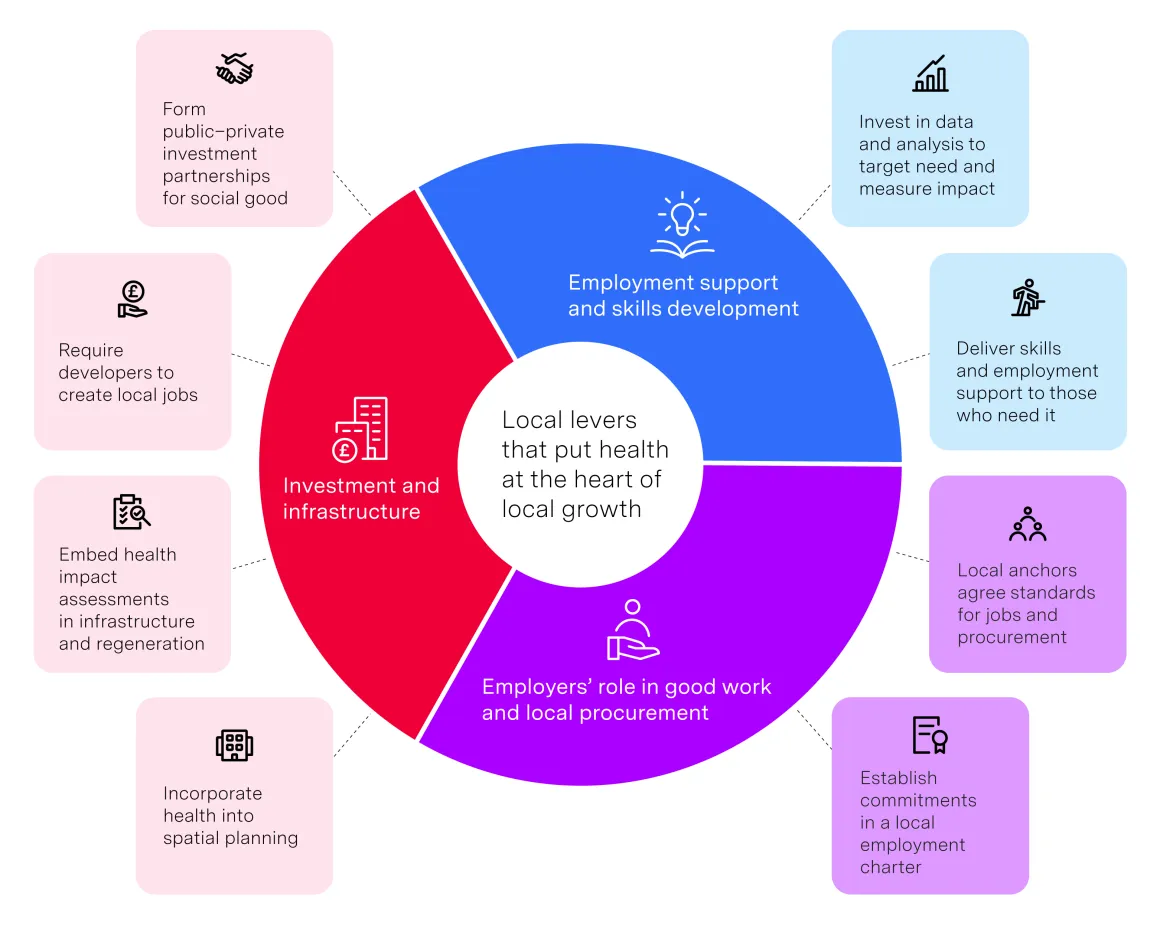
Local levers that put health at the heart of local growth across three key pillars of economic development

A diagram in the style of a doughnut chart, with the title in the centre: ‘Local levers that put health at the heart of local growth’. The three segments of the doughnut are: ‘Employment support and skills development’, ‘Employers’ role in good work and local procurement’ and ‘Investment and infrastructure’. Eight levers surround the segments.
 

Pillar 1: Employment support and skills development

Influence on the local economy 

Developing thriving local economies requires building capacity in the local working-age population and addressing the causes of economic inactivity due to ill health. People economically inactive due to ill health are overrepresented in areas of high deprivation. Employment interventions based around personalised support, integrated with health services, deliver better employment outcomes. This includes focusing on improving psychosocial factors such as mental health stressors, a person’s social environment and support networks and self-management skills.

Local government is the closest tier of decision making to employers and communities in a place, and benefits from a unique understanding of the skills gaps, sector growth, areas with high unemployment and vulnerable groups. Councils are in a position to work with schools, colleges and employers to align training with local demand. 

The Local Government Association’s analysis shows that for a medium-sized strategic authority (approximately 960,000 working-age people), a 15% improvement in employment and skills outcomes could lead to 1,650 additional people entering work annually, and 2,260 people improving skills. This could boost the local economy by £35m a year and save £23m a year in public spending. Critically, when health and wellbeing effects are included, the ‘wider benefits’ are estimated to more than triple – up to £87m a year for that area. For a larger combined authority, improvements could generate up to £260m a year in total economic and health and wellbeing benefits. 

Commissioning the right employment and skills support requires an in-depth understanding of the needs and potential of local communities, and unemployed or underemployed groups. Access to relevant health and work datasets is often limited or poorly applied in identifying future skills needs and capacity. This poses a barrier for skills providers and employers in creating and developing jobs that will underpin long-term local growth.

Influence on health

There is growing evidence that personalised support leads to better job and health outcomes for people with ill health, while employer engagement can ensure people are supported to remain in work once they get a job. Embedding joint health and employment outcomes, such as through the Individual Placement and Support (IPS) programme, demonstrates how improved wellbeing, higher job retention and better long-term recovery is possible for participants. There is an important opportunity to extend these benefits in the expansion of the IPS and Connect to Work programme. 

Skills development can improve people’s health at all stages of life. If interventions are effectively targeted towards the most excluded groups – young people not in education, employment or training (NEET) and people with long-term health issues – they can improve health by increasing opportunities to take up good-quality, well-paid work. As higher quality, well-paid work often requires higher levels of education and skills, skills provision can help people access areas of the labour market that might have otherwise been unattainable. Rising education levels among disabled people accounted for around 37% of the reduction in the disability employment gap in Great Britain between 2014 and 2022.

Being in employment and earning higher salaries have a positive impact on health, and apprenticeships and formal qualifications raise earnings. The Institute for Fiscal Studies shows a Level-3 apprenticeship is associated with 13% higher average earnings, and completing a full Level-3 qualification (A-level equivalent) about 16% higher. The Learning and Work Institute estimates restoring adult skills attainment to previous levels could unlock £22bn from reversing declines in adult literacy/numeracy and qualification levels. 

Lever: Invest in data and analytical capacity to target need and measure impact 

Without good use of data – and insight and involvement from partners who may identify need and refer people into services – there is a risk that training and skills programmes fail to meet real local needs. This would mean resources failing to reach groups most in need or facing the greatest barriers to employment. Data-poor areas are likely to fall further behind compared with places with better data and more resource to understand local challenges. They may be more vulnerable to industrial decline, automation and demographic change, with the local population ageing due to the out-migration of younger people seeking opportunities in more prosperous cities or regions. This is likely to lead to a persistent loss of productivity, increased welfare costs and act as a brake on growth potential. Patterns of severe health-related economic inactivity may be missed, leading to underinvestment or poor targeting of support services in work and health, reinforcing health inequalities. 

Case study 1:

Liverpool City Region Combined Authority (LCRCA), in partnership with the University of Liverpool, Liverpool John Moores University and the Heseltine Institute, developed a toolkit using micro-neighbourhood data to map and benchmark local support services and better target areas of high economic inactivity. This project was funded by the Health Foundation through the Economies for Healthier Lives programme. Locally sourced data are informing the design of interventions and the development of meaningful indicators to assess impact, while also supporting local and regional policymaking. 

The work led to a data sharing agreement between LCRCA and the NHS, enabling the linkage of records for up to 40,000 participants in the Households into Work and Ways to Work programmes with NHS data. Findings are informing discussions with the government on the Integrated Settlement from April 2026 and shaping the LCR Long Term Skills Plan and preparations for the Connect to Work programme. Although formal evaluation is ongoing, the universities have provided independent oversight, including data testing, assurance of governance arrangements, and support for the final data-linkage design.

Lever: Deliver skills and employment support to reach those who need it 

The people furthest from the labour market are young people who have never worked; people with long-term ill health or disabled people, particularly people with mental health issues; people lacking qualifications or work experience; care-leavers; and people facing complex disadvantage. These groups tend not to be ready for ‘rapid entry into jobs’ and often need more support than typical welfare-to-work programmes are designed to provide. Identifying and engaging with the ‘right’ economically inactive people is often challenging. It often requires an in-person, tailored approach with the right wrap-around-support in health and mental health, as well as addressing other needs like housing, transport and childcare. 

Delivering employment support in a community setting can strengthen engagement, lead to stronger trust and relationships and deliver better employment outcomes. Learning & Work Institute is leading the JobsPlus pilot programme, with support from Communities that Work, Institute for Employment Studies (IES) and Youth Futures. The programme focuses on on housing associations and their tenants, aiming to help people into work through on-site employment services, community support and financial incentives. 

Case study 2:

Supported by the Health Foundation, Havant Borough Council led a partnership with local schools, employers and Jobcentre Plus to address low educational attainment and youth unemployment. It launched an in-person Youth Employment Hub, funded by the Department for Work and Pensions, in 2022. The hub delivers tailored employment services for young people, including work coach support, access to new qualifications and routes into good-quality work that respond to local skills gaps. 

The YES Havant (YESH) placement scheme provided 6-month paid work placements for 18 to 24-year-olds, alongside structured support for participating employers. By 2025, more than 400 young people had accessed one-to-one support, over 350 had progressed into education or training and more than 315 had moved into employment. The YESH pilot partnered with 20 employers, supported 39 placements and achieved a 62% immediate job outcome rate. The University of Portsmouth evaluated the pilots and led a participative enquiry, including analysis of local and national socioeconomic impacts and links to crime prevention and reduced demand on NHS services.


Pillar 2: Employers’ role in good work and local procurement

Influence on the local economy

In areas with low productivity and growth, a reliance on low-wage sectors such as retail, warehouses, tourism and routine service jobs poses a barrier to economic growth and constrains economic potential. This becomes a vicious cycle that keeps productivity and incomes low, where places are dominated by sectors paying low wages, offering few opportunities for career progression and losing out by failing to attract large-scale investment. This low-wage-low-growth spiral is further compounded by the tendency for people with a higher level of skills to move away to more productive parts of the country. 

There are economic benefits to investing in ‘good work’ – both to the government and employers given the potential for productivity gains, lower employee absenteeism and reduced health-related costs. Work-related ill health costs the UK economy £21.6bn in 2022/23, driven by 34 million lost working days. The Keep Britain Working review shows that poor workplace health costs UK employers £85bn per year. This breaks down to £10bn related to statutory and occupational sick pay; £47bn in lost output from employee absence; £21bn lost productivity from presenteeism (working while unwell); and £7bn due to the costs of conflict resolution, litigation and recruitment.

The scope for councils to influence local economies with their own spending decisions is considerable. Nearly half of local government expenditure is accounted for by the services that councils procure. Local government can also shape local anchor activity in procurement to redress outsourcing to national or international companies, in which spending ‘leaks’ out of local economies. 

Developing local supply chains to grow community wealth has a ‘multiplier effect’ on the local economy, and public contracts are increasingly assessed not just on cost, but on outcomes such as local employment, training and community benefit. Local procurement supports SMEs, which constitute a large share of UK businesses and are central to employment. Ensuring public contracts are accessible to SMEs therefore helps sustain local economies, especially outside major metropolitan centres. For deprived areas, or places with low productivity, local procurement can be a means to channel investment into communities that might otherwise struggle to attract private-sector investment. 

Influence on health

Employment protections have a well-evidenced influence on employee health by providing predictable hours, sick pay and job security. Flexible working arrangements make employment more accessible for disabled people and those with caring responsibilities, while the protections enshrined in health and safety legislation guard against physical injury and make workplaces safer.

Anchor networks and accreditation schemes can improve working conditions across local supply chains, normalising good practice as standard bearers and by raising awareness, creating benchmarks and incentivising organisational change. Sustainable procurement can also grow community wealth and assets, influencing the environmental factors that affect health, such as air pollution, noise and urban heat. The impact is likely to be more limited, however, where practice is inconsistent and if insufficient attention is paid to implementation and measurement.

Lever: Local anchors agree standards for jobs and procurement

Economic development teams have trusted local relationships with employers, via both business and public sector employer groups, such as local anchor networks. This puts them in a unique position to influence at the point of job creation and foster a culture of good work – better standards in recruitment, retention and reputation, and in shaping local supply chains to create strong and vibrant local economies. As a collective framework, as with employment charters, commitments via an accreditation model can set shared expectations across a region.

Case study 3:

The Leeds Anchor Network anchor institutions, supported by Leeds City Council, have committed to increasing their collective contribution to the city’s economy and communities, by embedding good employment practices and improving health and wellbeing. This work was supported by the Health Foundation’s Economies for Healthier Lives programme. The Leeds Business Anchors programme supports businesses to self-assess their local impact while the Leeds Anchor Playbook provides a shared framework and metrics, including on local spending, workforce residence in deprived areas and health-related outcomes. 13 anchor institutions and 10 businesses have completed the anchor progression framework, making progress through targeted recruitment into health and care, increased ethnic diversity, growth in the proportion of employees living in Leeds (64% of the anchor workforce are based in Leeds) and from disadvantaged areas (31% of the Leeds workforce), and reported improvements in mental health. The programme has also delivered cross-industry work experience for young people. 

An independent evaluation by the Warwick Institute for Employment Research and York Consulting found strengthened connections between anchor institutions, local communities, the voluntary and private sectors, alongside improved economic activity and better alignment between anchors’ employment practices and positive health outcomes.

Case study 4:

Salford City Partnership, supported by the Health Foundation, has pursued a community wealth-building approach focused on establishing new social and cooperative businesses and working with local anchor institutions to shift spending towards local goods and services. Through initiatives such as the Economics with people series and Fairer, Greener, Healthier: our grower’s guide to nurturing an inclusive and green economy, they engaged local residents not in education or employment. A catering social enterprise and café began trading in March 2025, with anchor contracts in development. The work has influenced Salford City Council’s Corporate Plan 2024–2028 and the forthcoming Tackling Poverty and Inequality Strategy include commitments to progressive procurement, fair employment practices and the Salford Local Anchors Network. Community wealth building is now a core objective within Greater Manchester’s Live Well programme, with interest from other boroughs including Manchester, Rochdale and Stockport. 

A local evaluation by the University of Salford (2025) found participants reported improvements in wellbeing, confidence and self-efficacy. Further support for new social enterprises will be provided through the Salford Employment Hub.

Lever: Establish commitments in a local employment charter

Employment charters are voluntary frameworks or pledges adopted by local authorities, regions or employers in the UK to promote standards of good employment practice. This can include measures around fair pay, secure contracts, workforce wellbeing, training opportunities, inclusion and employee voice. There is evidence that they can make a meaningful difference in promoting good health and good work, when backed by strong local leadership and buy in from employers.

Case study 5:

Greater Manchester Combined Authority, working with employers, trade unions and advisory bodies, such as Acas and CIPD, developed the Greater Manchester Good Employment Charter. It aims to raise employment standards and support economic growth by promoting good jobs, fair pay and healthy workplaces. The Good Employment Charter sets out seven core characteristics of good employment: secure work; flexible work; pay; employee voice; recruitment; people management; and health and wellbeing. Employers are supported by practical resources, including a mental health toolkit and a neurodiversity resource hub. The charter has engaged more than 2,000 employers, with over 900 supporters and over 150 members, collectively covering over 1 million employees. All 10 Greater Manchester councils have become members. 

An independent evaluation by Manchester Metropolitan University found a strong commitment among participating organisations to strengthen existing good practice and develop new approaches across the charter’s priority areas. Manchester Metropolitan University has produced a transferable toolkit to support other regions seeking to adopt similar charter-based models.


Pillar 3: Investment and infrastructure

Economic development teams help to create the conditions for business growth by attracting investors and building infrastructure to support new and existing businesses. A skilled workforce and assets, such as housing stock, transport links and a good-quality of life, are critical to making the case for businesses to invest in an area. These same assets shape local residents’ daily living conditions and, in turn, their health.

Areas in the UK that have faced historical underinvestment have often been held back by a high prevalence of ill health. The government has recognised the relationship between raising productivity and supporting the long-term growth of the UK’s major city regions, viewing investment as a way to develop untapped potential and create good-quality jobs. Between 2013 and 2022, gross value added (GVA) per head is assessed to have been 30% lower in the north of England, compared with the rest of England. 36% of this ‘gap’ can be attributed to poor health. Closing the health gap between the north of England and the rest of England could put an extra £18.4bn into the economy per year.

Considering health in the design and delivery of new infrastructure and regeneration projects is essential to both ensure that infrastructure does not exacerbate health inequalities, and so that opportunities are taken to strengthen economic performance by improving both health and infrastructure. In commissioning large-scale investment projects, regional and local authorities can introduce requirements for developers to contribute directly to local skills and employment. This will ensure that they deliver for the economy now and in the long term by building work capacity.

Influence on health

Weak infrastructure and investment reduces employment opportunities and access to healthy food and education, entrenching low productivity. It also makes communities more isolated and less connected to public services. Investing in these important social assets, such as active travel, green spaces and community centres, would also be likely to prevent more poor health in the first place.

Sub-standard housing and underinvestment in housing infrastructure directly harm health. Damp, mouldy and cold homes are causally linked to respiratory disease, poor mental health and excess winter deaths. 1 in 4 households in the UK live in cold or damp accommodation. It is estimated that it costs the NHS in England around £1.4bn a year to treat people affected by poor housing, around two-thirds of which (£895m) can be attributed to housing defects that expose residents to excess cold or damp.

Upgrading physical infrastructure – such as cycle routes and public transport – reduces air pollution, enhances mobility and increases access to employment opportunities. Encouraging active travel, such as walking and cycling, supported by safe infrastructure and traffic calming, results in health benefits such as increased physical activity, fewer sick days and lower mortality risk. Low-traffic interventions in outer London have yielded a £4,800 per person health benefit over 20 years from increased physical activity. 

Investment in social infrastructure – such as cultural centres, libraries and community hubs – is strongly associated with healthier communities, promoting social cohesion and mental wellbeing that in turn yields public health benefits. Planning, design and community involvement will determine whether new infrastructure worsens health outcomes for local residents. There is growing recognition of the potential for planning to improve health and the economy, in the LGA and Quality of Life Foundation’s Empowering Healthy Place guide and by the Town and Country Planning Association.

Lever: Embed health impact assessments in infrastructure and regeneration 

In evaluating how infrastructure projects affect population health, health impact assessments can anticipate and mitigate negative health impacts (eg air pollution, noise, unsafe walking environments). They can create cost savings for local authorities and businesses by reducing long-term health care costs and lost productivity. 

Case study 6:

Glasgow City Region, in collaboration with Public Health Scotland and the Glasgow Centre for Population Health, and supported by the Health Foundation, developed the capital investment health impact assessment (CHIA) – an online toolkit to embed health and equity considerations in major infrastructure and regeneration projects. The toolkit guides economic development and capital investment teams through a tailored health impact assessment process, providing practical resources and a collaborative space to support integration of health outcomes in project planning, design and delivery. 

The CHIA toolkit is being piloted in seven capital projects in the city region, spanning transport, commercial development and town centre regeneration, including initiatives in Glasgow city, North and South Lanarkshire and East Renfrewshire. Pilot projects include Clyde Metro, the Regional Electric Vehicle Charging Infrastructure programme, the Regional Investment Zone and local authority schemes, such as Glasgow city council’s energy efficiency housing retrofit, East Renfrewshire’s Barrhead masterplan, South Lanarkshire’s East Kilbride masterplanning and North Lanarkshire’s East Airdrie Link Road. 

A formative evaluation, led by the Glasgow Centre for Population Health, assessed how effectively CHIA is being integrated into capital investment decision making, with all Glasgow City Region local authorities formally pledging their support and participation in roll out of the approach. The pilot projects using the tool have also been evaluated.

Lever: Require developers to create local jobs 

Requirements for developers to contribute to skills and employment through the delivery of a project can support local workforce development and also attract future investment as businesses seek places with ready, qualified labour. These are often embedded in planning approvals, Section 106 agreements, or social value clauses.

Case study 7:

Westminster’s City plan sets the policy framework for ensuring new developments help facilitate improved employment prospects for local residents and major developments are required to support this. As outlined in the council’s Planning Obligations and Affordable Housing supplementary planning document (SPD), this includes: financial contributions towards employment; education and skills initiatives; and for larger schemes, the submission and implementation of an employment and skills plan (ESP). This will help ensure Westminster’s residents directly benefit from the city’s economic growth, and the opportunities this brings – both in the end use of a development and during its construction phase. 

All jobs for Westminster residents secured through the agreement are to be paid as a minimum London Living Wage, and all apprenticeships as a minimum National Minimum wage. The council also uses Section 106 legal agreements to secure the submission and implementation of an agreed ESP for larger schemes. The council’s first-ever social value statement embeds social, economic and environmental value into how the council works with suppliers, developers and partners. It provides greater transparency on expectations for supplier contributions and how social value is integrated into procurement and service delivery, reinforcing the council’s commitment to meaningful and measurable community impact.

Westminster City Council is currently undertaking formal consultation on an update to the SPD and the associated draft inclusive local economy and employment guidance note. This proposes improving developer contribution to employment and skills through a requirement for apprenticeships shared with the employment service for recruitment support to be paid at least London Living Wage. The proposal also includes a stronger emphasis on opportunities for local residents, and to introduce flexibility so that contributions can also support other connected areas, such as strategic employment and skills initiatives, enterprise support programmes, sector-specific skills pipelines and business growth projects.

Lever: Incorporate health into spatial planning 

Urban planning that results in residents being able to meet most of their daily needs within a 20-minute journey from their home (such as travelling to work, school, shops or to health care, leisure facilities and for public transport) can deliver significant local economic benefits. When residents can access amenities and services nearby, more spending stays within the local area. Compact, mixed-use neighbourhoods generate local jobs in retail, services, education, health and leisure. Vibrant, walkable neighbourhoods with easy access to amenities are therefore attractive to businesses, developers and residents.

Case study 8:

Our Seven Towns is a borough-wide spatial and delivery framework setting out how Ealing’s seven towns will function as healthy, walkable 20-minute neighbourhoods. The guidance establishes clear expectations for developers, partners and the council, ensuring residents can access daily needs – such as health care, shops, schools, parks, workspaces and community facilities – within a short walk or cycle.

The approach is underpinned by ‘sustainable polycentrism’ – a concept that involves multiple, interconnected centers of activity operating in an environmentally sustainable, socially inclusive and economically resilient way over the long term. This approach directs growth and investment to strengthen local economies, reinforce town centres and reduce inequalities in access to services and infrastructure. The framework embeds active travel, greening, social infrastructure and local employment as core components of new development and regeneration. It also provides a consistent, evidence-led basis for shaping regeneration and development proposals. Town-level priorities identify specific gaps in amenities, green space, employment space and connectivity, helping to target investment where it will have the greatest health and wellbeing benefits.

Lever: Establish public–private partnerships to attract large-scale investment for social good

Collaboration between regional and local government and private-sector entities to finance, build and operate infrastructure, or deliver public services, offers multiple benefits to the local economy. Mobilising private capital for public projects facilitates large-scale infrastructure projects (roads, schools, hospitals, social and affordable housing) without local or regional government bearing the entire upfront cost. By leveraging private investment, local and regional government can accelerate economic development and create jobs that stimulate local economies. Embedding health as a core metric in public–private investment partnerships for social-good requires deliberate design choices across governance, financing, measurement and accountability. Making improving health a primary objective, integrating health into governance processes and standardising health metrics in reporting, will ensure that major investment partnerships are leveraged for both health and economic benefits. 

Case study 9:

Bristol City Leap is a 20-year joint venture, launched in 2022 between Bristol City Council, Ameresco and Vattenfall Heat UK, designed to unlock more than £1bn of investment in the city’s low-carbon energy infrastructure. The programme delivers large-scale retrofit and energy efficiency upgrades, including insulation, ventilation and new doors and windows. Explicitly linking decarbonisation to physical and mental health benefits, the programme is supporting a ‘just transition’ that reduces fuel poverty and improves housing quality for vulnerable residents. 

Projects totalling more than £51m include electric vehicle infrastructure; social housing energy efficiency; retrofit support for owner-occupiers at risk of fuel poverty; upgrades to the council’s corporate estate; and renewable energy generation on council-owned sites. In 2024, £15.78m was spent through local supply-chain contracts with micro, small and medium-sized enterprises, alongside £66,000 with the voluntary, community and social enterprise sector. This created 102 local jobs, 54 weeks of apprenticeships, 361 hours of careers support and 44 weeks of work experience for young people. The model has informed the Local Net Zero Accelerator pilot in York and North Yorkshire Combined Authority, launched in 2023, although no formal evaluation of residents’ health outcomes has yet been published.


Conclusion

Improving people’s health, especially in the UK’s most deprived communities, is an economic necessity. Poor health reduces individuals’ ability to participate fully in the labour market and drives wider regional economic inequalities. Addressing ill health is therefore essential to boost productivity, support inclusive growth and strengthen the economy as a whole.

We have set out local levers that show some of the ways economic development activities can improve health. Employment support and skills development provide the foundation: helping people overcome barriers linked to ill health and equipping them with the capabilities to access and progress in work. This creates a more resilient, adaptable local workforce. 

Together these levers are mutually reinforcing: skilled residents attract higher quality jobs; good work makes places more competitive for inward investment; and healthier, better connected places support further growth. This virtuous circle underlines why economic development teams are central to building local economies that are both prosperous and healthy. 

Local government and strategic authorities have the potential to create healthy places for residents and communities. But we also recognise that national government creates the enabling conditions for success. Support from national government is needed to enable closer working between public health and economic development teams in the design and delivery of effective interventions, and to ensure teams are sustainably funded and resourced. Devolution holds a great deal of promise. However, to capitalise on the opportunities on offer, all efforts must be oriented towards improving health and building stronger local economies. 

Annex

Annex 1: Local levers that put health at the heart of local growth
(2.22 MB)

Further reading

You might also like...